Pond Aeration Chart (Air Pump Size by Gallons)
Pond aeration sizing chart: air pump class and diffuser count by pond volume from 250 to 10,000 gallons, using one diffuser per 2,000 gallons, plus summer and winter diffuser placement.
Quick answer: Run about one diffuser per 2,000 gallons (minimum one), fed by an air pump sized to your volume: small under 1,000 gallons, medium for 1,000 to 3,000, large for 3,000 to 8,000, and pond or commercial class above 8,000 gallons. Heavily stocked koi ponds and hot climates need roughly a third more. Place diffusers deep in summer and on a shallow shelf in winter.
Aeration is the cheapest life insurance a koi pond can buy. The air pump pushes air down to diffusers near the bottom, and the rising bubble column both dissolves oxygen and lifts stale bottom water to the surface where gas exchange happens. The chart below sizes the whole system from one number, your pond volume in gallons, with a second column for the heavy-koi and hot-climate case.
Know your volume first with the pond volume calculator, then get a sizing tailored to your stocking with the pond aeration calculator.
Pond aeration chart by volume
Diffuser counts use one per 2,000 gallons, rounded up. The heavy column applies a 1.3 multiplier for dense koi stocking or hot climates.
| Pond volume (US gal) | Air pump class | Diffusers (normal) | Diffusers (heavy koi / hot climate) | Typical pond |
|---|---|---|---|---|
| 250 | Small | 1 | 1 | Patio or container pond |
| 500 | Small | 1 | 1 | Small goldfish pond |
| 750 | Small | 1 | 1 | Goldfish pond |
| 1,000 | Medium | 1 | 1 | Entry koi pond |
| 1,500 | Medium | 1 | 1 | Small koi pond |
| 2,000 | Medium | 1 | 2 | Koi pond |
| 3,000 | Medium to large | 2 | 2 | Established koi pond |
| 4,000 | Large | 2 | 3 | Large koi pond |
| 6,000 | Large | 3 | 4 | Large koi pond |
| 8,000 | Large | 4 | 6 | Display pond |
| 10,000 | Pond / commercial | 5 | 7 | Small lake or show pond |
Aeration Kits by Pond Size

AquaMiracle All-in-One Koi Pond Aerator Kit, up to 1000 gal
Small-class air pump with diffuser and tubing for ponds under 1,000 gallons.
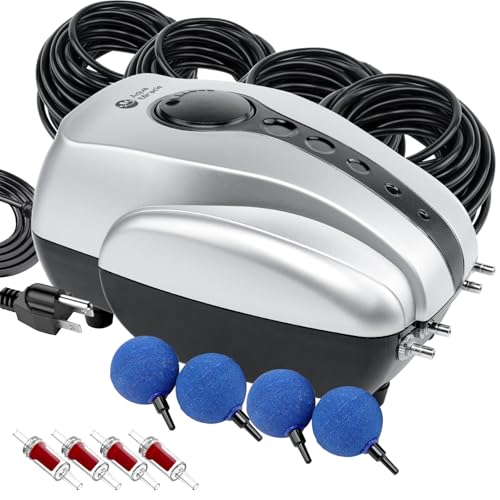
AquaMiracle All-in-One Koi Pond Aerator Kit, up to 2000 gal
Medium-class aeration kit for 1,000 to 2,000 gallon koi ponds.
Diffuser placement: summer vs winter
| Season | Diffuser depth | Goal |
|---|---|---|
| Spring and summer | Deep zone, raised slightly off the bottom | Lift low-oxygen bottom water to the surface; full circulation |
| Fall | Deep zone until water nears 50 F | Keep oxygen up while fish feed heavily before winter |
| Freezing winter | Shallow shelf, about 1 ft deep, gentle flow | Hold a gas-exchange hole in the ice without chilling the deep zone |
The winter row matters more than it looks. Koi overwinter in the deepest water, which stays a few degrees warmer than the surface. A diffuser left at full depth mixes that warm refuge away and can supercool the fish. Move it shallow, run it gently, and add a floating de-icer in hard-freeze climates. The full cold-season routine is in the overwintering koi guide.
When aeration is non-negotiable
- Hot, still summer nights. Warm water holds less oxygen, and at night plants and algae consume it instead of producing it. Most summer fish kills happen just before dawn.
- Heavy koi stocking. Koi are large, active, heavy-waste fish. If your pond is near the limits on the koi stocking chart, continuous aeration is mandatory, not optional.
- During treatments. Salt, medications, and algaecides can all depress oxygen or raise demand. Extra air is standard practice whenever you treat.
- Power or pump failure backup. A small independent air pump keeps fish alive for days if the main water pump dies, because oxygen, not filtration, is what kills quickly.
Air pump vs water pump
These two pumps solve different problems and are sized differently. The water pump is sized in gallons per hour against your volume for filtration turnover, covered in the pump turnover chart. The air pump is sized by the classes above, plus one spec worth checking on the box: its rated operating depth. Pushing air down 4 feet takes meaningfully more pressure than 18 inches, so a pump that is generous on paper can be weak at the bottom of a deep koi pond. Pick the class from the chart, then confirm the maker rates it for your depth and diffuser count.
Running an indoor tank as well? Our sister site FishTankCalculator.com sizes aquarium air pumps and filters the same way.
Frequently Asked Questions
What size air pump does my pond need?
Size the air pump to your gallons. Ponds under 1,000 gallons do well with a small aerator drawing only a few watts, 1,000 to 3,000 gallons want a medium pump, 3,000 to 8,000 gallons want a large pump, and anything over 8,000 gallons moves into pond or commercial aerator territory. Then confirm the manufacturer rates the pump for your pond depth, since pushing air deeper takes more pressure.
How many air stones or diffusers do I need?
Use about one diffuser for every 2,000 gallons, with a minimum of one for any pond. A 1,500 gallon pond runs a single diffuser, a 4,000 gallon pond runs two, and a 6,000 gallon pond runs three. For heavily stocked koi ponds or hot climates, step the count up by roughly a third, because crowding and heat both drive oxygen demand higher. Several small diffusers spread around the pond mix better than one big stone in a corner.
Where should pond diffusers be placed?
In the warm months, place diffusers in the deeper area of the pond, raised slightly off the bottom on a base so they do not clog with sludge. The rising bubble column lifts low-oxygen bottom water to the surface where gas exchange happens. In freezing winters, move the diffuser up to a shallow shelf, about a foot deep, and run it gently. Deep winter aeration mixes away the warm bottom layer where koi rest, which can be dangerous.
Is an air pump different from a water pump?
Yes, they do different jobs. The water pump moves water through your filter and waterfall and is sized in gallons per hour against pond volume. The air pump pushes air through tubing to diffusers, adding dissolved oxygen and gently mixing the water column. Most koi ponds benefit from both, because strong circulation does not guarantee high oxygen, especially in deep ponds and during hot, still summer nights.
Should a pond aerator run all the time?
For a stocked koi pond, yes, run aeration 24 hours a day. Oxygen crashes happen mostly at night, when plants and algae stop producing oxygen and start consuming it, so overnight is exactly when the aerator earns its keep. The power draw of a properly sized air pump is small, typically far less than the water pump, and continuous gentle aeration is cheap insurance against the classic hot-night fish kill.
Do koi ponds need aeration in winter?
Yes, but the goal changes. In winter the aerator keeps a small area of surface agitated so a hole stays open in the ice, letting toxic gases escape and oxygen enter. Move the diffuser to a shallow shelf, run it gently, and pair it with a floating de-icer in hard-freeze climates. Do not aerate the deepest zone in winter, since that supercools the warm layer where the koi are dormant.
Planning or running a pond?
Use our free calculators and guides to get every number right.
Pond Planner: $39