Pond pH and Why Stability Matters
The ideal koi pond pH is about 7.0 to 8.5, but stability beats any exact number. Learn how KH buffers pH, why dawn pH crashes are dangerous, and why you should never chase the pH reading.
The ideal pH for a koi pond is roughly 7.0 to 8.5, but here is the part that matters more than any number: koi need stability, not a perfect reading. A pond that holds steady at 8.2 is healthier than one swinging from 7.0 to 8.5 every day. Stable pH comes from adequate KH, the carbonate buffer that neutralizes the acids your pond constantly produces. Manage KH and pH takes care of itself. Chase the pH number with chemicals and you create the very instability that harms fish.
Test Kits to Track pH and Buffering

API POND MASTER Test Kit (500-Test)
$34.98 on Amazon
Liquid kit with a precise pH test plus ammonia and nitrite, the readings that matter most together.
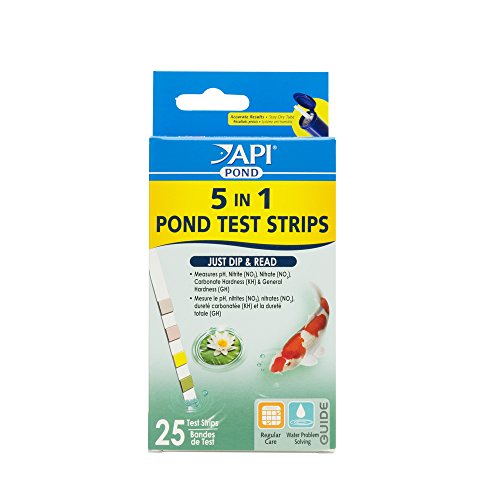
API Pond 5-in-1 Test Strips (25-ct)
$14.98 on Amazon
Fast dip strips that read pH, nitrite, nitrate, and crucially KH and GH for buffering.

JNW Direct 7-in-1 Pond Test Strips (50-ct)
$12.99 on Amazon
Budget strips covering pH, carbonate, alkalinity, nitrite, and nitrate for routine checks.
What pH means in a pond
pH measures how acidic or alkaline the water is on a scale from 0 to 14, where 7 is neutral, below 7 is acidic, and above 7 is alkaline. The scale is logarithmic, so each whole number is a tenfold change, a pond at pH 6 is ten times more acidic than one at pH 7. That is why even a swing of one point is a big deal to fish. Koi are adaptable and live comfortably across a broad band, but their bodies hate rapid change far more than they mind a steady reading that is slightly off the textbook ideal.
Stability beats the perfect number
This is the central lesson of pond pH: do not chase a number, protect stability. Koi can acclimate to a pond that consistently sits at 7.4 or at 8.4. What stresses them, weakens their immune systems, and can kill them is pH that lurches around, especially a sudden drop. Every time pH swings, fish must work to rebalance their internal chemistry. A stable pond, even at a slightly imperfect pH, is a healthy pond.
So when you test, you are really watching for consistency. Test at the same time each day for a while to learn your pond's rhythm. If the reading holds steady within the safe range, you are in great shape, even if it is not exactly 7.5.
| pH reading | For koi | What to do |
|---|---|---|
| Below 6.5 | Too acidic, buffer likely depleted | Test KH urgently, raise buffering |
| 7.0 to 8.5 | Healthy range | Keep it stable, monitor KH |
| Above 9.0 | High, raises ammonia toxicity | Check ammonia, investigate cause |
| Swinging daily by 1+ point | Unstable, stressful | Buffer KH, reduce algae |
KH: the buffer that holds pH steady
You cannot understand pond pH without understanding KH, or carbonate hardness. KH is the amount of dissolved carbonate and bicarbonate in your water, and it acts as a chemical shock absorber. Your pond constantly produces acids, from fish waste, decaying organic matter, and the nitrogen cycle itself, all of which push pH down. KH neutralizes those acids before they can move the pH. As long as KH stays adequate, pH resists change and holds steady.
The problem comes when KH runs out. Those acids never stop being produced, so once the buffer is exhausted, there is nothing left to absorb them and pH plummets, sometimes overnight. This is a pH crash, and low KH is its root cause almost every time. The takeaway: if you want stable pH, manage KH, not pH. We cover the testing and dosing in detail in pond KH and GH.
How to keep KH adequate
- Test KH, not just pH. A pH reading alone hides a depleting buffer. Strips that include KH or carbonate hardness, or a dedicated KH test, warn you before a crash.
- Add a carbonate source when KH is low. Baking soda (sodium bicarbonate) is the simplest way to raise and stabilize KH. Dose to your real volume and raise it gradually.
- Do regular partial water changes. Fresh tap water usually replenishes some buffering, though it varies by region, so test your source water too.
- Remove decaying organics. Rotting leaves and sludge produce acids that eat through your buffer faster.
Whenever you dose anything to the pond, including buffer or salt, work from your true gallons. Confirm them with the pond volume calculator, and if you also keep pond salt in the water, size it with the pond salt calculator so treatments stay accurate.
The dawn pH crash and the daily swing
If you have ever found your koi gasping at sunrise, the daily pH cycle may be the reason. Plants and algae photosynthesize during the day, pulling carbon dioxide out of the water, which pushes pH up. At night they stop photosynthesizing and instead release carbon dioxide, which pushes pH back down. So in a typical pond, pH is lowest at dawn and highest in late afternoon.
A small daily swing is normal and harmless. But in a pond with weak KH and heavy algae, that overnight drop can become severe, a genuine dawn crash that stresses or kills fish before you even wake up. Two things prevent it: strong KH buffering, which limits how far pH can fall, and controlling algae so the nightly carbon dioxide surge is smaller. If you are battling blooms, see how to control pond algae, because algae and pH instability often go hand in hand.
Why you should not chase the pH number
It is tempting to grab a bottle of pH-up or pH-down and force the reading to where you want it. Resist. These products move pH temporarily, but they do nothing to fix the underlying buffering. Without adequate KH, the pond bounces right back to where it was, and now you have added a swing, the exact instability that harms koi. You can end up in a frustrating cycle of dosing, rebounding, and dosing again, stressing your fish each time.
The correct approach is upstream: manage KH so pH stabilizes naturally, control algae so daily swings stay small, remove organic waste so acid production slows, and do regular water changes. Fix the foundation and the pH number settles where it belongs and stays there. Keeping fish indoors as well? The same buffering logic applies to aquariums, covered on our sister site FishTankCalculator.com.
A simple pH routine
- Test pH and KH together, at the same time of day, weekly.
- Aim for stable pH in the 7.0 to 8.5 band, not a specific number.
- If KH is low, raise it gradually with a carbonate source and retest.
- Never use pH-adjusting chemicals as a routine fix.
- Control algae and remove organics to limit daily swings.
- Always check ammonia alongside pH, since high pH makes ammonia more toxic.
Stable pH is the quiet foundation of a healthy koi pond, and it is built on KH, not on chasing the pH reading. Keep the buffer adequate, control algae, remove waste, and your pond holds steady through day and night. Next, get the buffering details right in pond KH and GH, and understand how pH interacts with toxins in the pond nitrogen cycle.
Pond Build & Maintenance Planner
Build planner, stocking planner, water-test log, and seasonal maintenance schedule, in one printable planner that keeps your pond healthy year-round.
Frequently Asked Questions
What is the ideal pH for a koi pond?
Koi thrive across a fairly wide range, roughly 7.0 to 8.5, and what matters most is stability, not hitting one exact number. A pond holding steady at 8.2 is far healthier than one bouncing between 7.0 and 8.5 every day. Test at the same time each day to learn your pond, and focus on keeping the reading stable rather than chasing a textbook ideal.
What makes pond pH crash?
A pH crash happens when the water loses its buffering capacity, measured as KH or carbonate hardness. Acids from fish waste, decaying organics, and the nitrogen cycle steadily consume KH. Once KH runs out, there is nothing left to neutralize those acids and pH drops suddenly, sometimes overnight. Low KH is the root cause of almost every dangerous pH crash, so buffer first.
Why does my pond pH change between morning and evening?
Daily pH swings are driven by plants and algae. During the day they consume carbon dioxide for photosynthesis, which raises pH. At night they stop and release carbon dioxide, which lowers pH, so pH is typically lowest at dawn and highest in late afternoon. A small daily swing is normal. Large swings signal weak buffering, heavy algae, or both, and stress fish.
Should I use pH-adjusting chemicals?
Usually no. pH-up and pH-down products force a number temporarily, but without fixing buffering the pond bounces right back, creating the very instability that harms koi. The lasting fix is to manage KH, which buffers pH naturally. Adding a carbonate source like baking soda raises and stabilizes KH so pH holds steady on its own. Do not chase the pH number directly.
How does KH protect pond pH?
KH, or carbonate hardness, is the water dissolved carbonate and bicarbonate that acts as a buffer. It neutralizes the acids constantly produced by fish waste and the nitrogen cycle, holding pH steady. As long as KH stays adequate, pH resists sudden change. When KH is depleted, pH becomes unstable and prone to crashing. Keeping KH in a healthy range is the real secret to stable pH.
Is high pH dangerous for koi?
Very high pH, above about 9, becomes a problem mainly because it sharply increases ammonia toxicity. The same ammonia reading is far more harmful at high pH than at neutral, so a pond with both high pH and any ammonia is risky. For most backyard ponds, slightly alkaline water around 7.5 to 8.5 is fine and healthy, provided ammonia stays at zero and the pH is stable.
Planning or running a pond?
Use our free calculators and guides to get every number right.
Pond Planner: $39